Financial organizations operate in an environment where the speed and quality of data can directly influence business performance. Investment firms, financial data platforms, fintech companies, asset managers, private market intelligence providers, and research organizations depend on large volumes of structured and unstructured information every day.
This information may come from annual reports, regulatory filings, earnings releases, investor presentations, company websites, market announcements, transaction databases, news articles, and other financial information sources.
Collecting the information is only the beginning.
Before financial data can support research, analytics, investment decisions, or client-facing products, it must be collected, standardized, enriched, validated, classified, and continuously updated.
Managing all these activities internally can require significant investment in recruitment, training, technology, quality assurance, and operational management. As data coverage expands, internal research teams may spend increasing amounts of time on repetitive data processing rather than high-value analysis.
This is one of the main reasons organizations work with a specialist financial data outsourcing company.
Financial data outsourcing allows businesses to build dedicated teams that support data collection, financial research, enrichment, validation, annotation, and ongoing database maintenance. When structured correctly, the model can improve business efficiency by reducing operational bottlenecks, increasing research capacity, improving data consistency, and allowing internal experts to focus on strategic activities.
This article explores how financial data outsourcing improves business efficiency and why dedicated data operations are becoming an important part of modern financial information businesses.
What Is Financial Data Outsourcing?
Financial data outsourcing is the process of engaging a specialized external team to perform defined financial research and data operations activities.
Unlike purchasing a standardized financial database, outsourcing allows an organization to create customized workflows based on its own methodology, taxonomy, technology platform, and data requirements.
A financial data outsourcing company can provide dedicated professionals who work as an extension of the client’s existing data and research organization.
Depending on the business requirement, the outsourced team may support company research, financial statement data collection, document sourcing, historical data development, transaction research, executive and company intelligence, data enrichment, quality assurance, and ongoing database maintenance.
For example, a private markets intelligence platform may require researchers to identify funding transactions, investors, company information, executive changes, and acquisition activity.
An investment research platform may need teams to collect financial information from company filings, monitor corporate announcements, update business profiles, and verify changes in company fundamentals.
The outsourcing model allows these organizations to increase research capacity without building every operational capability internally.
However, successful financial data outsourcing requires more than simply transferring tasks to an external provider. The strongest operating models are built around dedicated teams, documented research guidelines, measurable quality standards, technology integration, and continuous communication between internal and external teams.
Why Financial Data Operations Become a Business Efficiency Challenge
As financial data businesses grow, their operational requirements often increase faster than expected.
A financial information platform may initially cover 1,000 companies and later expand to 10,000 or more. An investment research firm may decide to add new sectors, geographies, asset classes, or alternative datasets.
Each expansion creates additional data operations work.
New companies must be researched. Historical information may need to be collected. Existing records must be updated. New sources must be monitored. Data quality must be reviewed continuously.
Internal analysts can quickly become overwhelmed by operational tasks.
Highly skilled financial professionals may find themselves spending significant amounts of time downloading reports, locating data points, updating spreadsheets, checking source links, or resolving basic database exceptions.
These activities are necessary, but they may not represent the best use of specialist expertise.
A financial data outsourcing company can help separate strategic research from scalable data operations.
Internal teams can focus on methodology, interpretation, investment insights, product development, and client engagement, while dedicated data operations teams manage repeatable research and processing activities.
This division of responsibilities can significantly improve organizational efficiency.
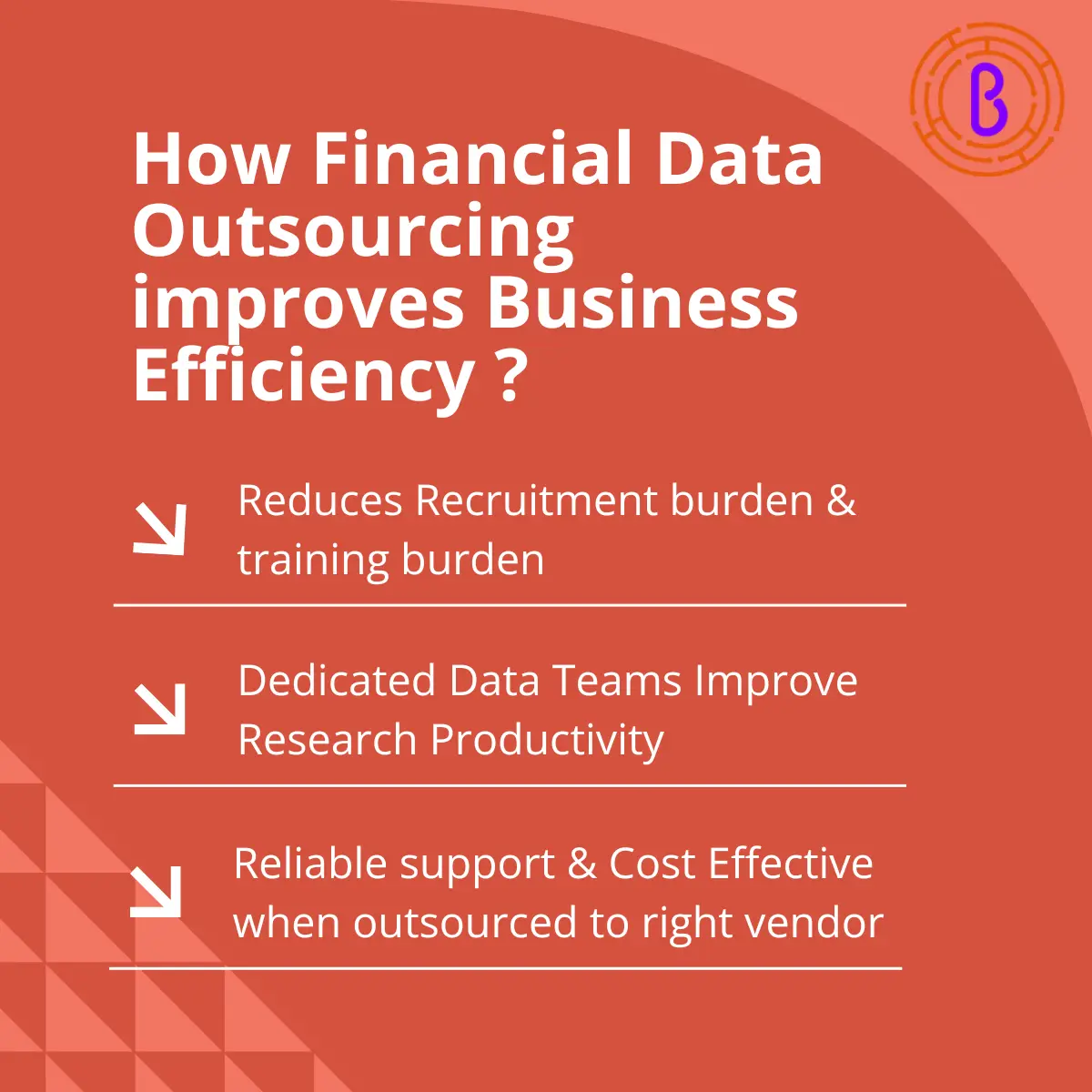
1. Financial Data Outsourcing Reduces Recruitment and Training Burden
Building an internal financial data operations team requires considerable management effort.
Organizations must define roles, recruit suitable candidates, conduct interviews, onboard new employees, develop training materials, monitor performance, and manage employee turnover.
Recruitment becomes more difficult when the organization requires professionals who understand financial statements, corporate structures, investment terminology, and data research methodologies.
Even after recruitment, employees require significant training before they can work independently on complex datasets.
Financial data outsourcing provides an alternative approach.
A specialized provider can recruit professionals based on the client’s requirements and build a dedicated team around the project.
The client still plays an important role in methodology training and process design, but the operational burden of sourcing candidates, managing infrastructure, and maintaining team continuity is reduced.
Once the initial team is established, documented workflows and training materials can support more structured scaling.
This allows organizations to increase capacity without repeatedly building recruitment and operational infrastructure from the beginning.
2. Dedicated Data Teams Improve Research Productivity
Research productivity is not simply about how many records an analyst can process in a day.
Effective productivity means assigning the right type of work to the right level of expertise.
Consider an investment analyst responsible for evaluating companies within a particular industry. The analyst may need revenue history, management changes, acquisition activity, product information, competitive intelligence, and other company-level data.
If the analyst spends several hours collecting and organizing this information manually, less time is available for analysis.
Providers of investment research data services can support the underlying data collection and preparation process.
A dedicated team can research companies, collect defined data points, maintain source links, update records, and flag unusual situations for review.
The internal analyst receives structured information and can focus on interpretation rather than basic collection.
This does not remove human expertise from the research process. Instead, it improves how specialist expertise is used.
Experienced investment professionals focus on making judgments, developing investment views, and identifying opportunities. Data operations teams focus on creating and maintaining the structured information required for those decisions.
3. Outsourcing Makes Financial Data Operations More Scalable
Data requirements are rarely constant.
A financial data business may need additional capacity when launching a new dataset, entering a new market, building historical coverage, or onboarding a large client.
Recruiting permanent internal employees for temporary increases in workload may not always be commercially efficient.
A financial data outsourcing company can provide a more flexible operating structure.
For example, an organization building a historical private company dataset may require a large research team for several months. Once the historical dataset is completed, a smaller team may be sufficient for ongoing maintenance.
Similarly, a financial intelligence platform entering a new geography may need researchers to develop initial coverage before transitioning to a regular update cycle.
A scalable outsourcing model can align team size with the actual stage of the data operation.
However, scalability must be managed carefully. Adding more researchers without structured training and quality assurance can create inconsistencies.
Effective scaling therefore requires documented research procedures, example libraries, exception logs, reviewer feedback, calibration sessions, and measurable quality benchmarks.
4. Financial Data Outsourcing Improves Data Quality
Poor data quality creates hidden costs throughout an organization.
Incorrect financial values can affect analytical models. Duplicate company records can distort market analysis. Outdated executive information can reduce the value of business intelligence platforms.
Data quality issues also consume employee time.
When analysts do not trust a dataset, they begin manually checking information before using it. This creates duplicate effort and reduces the efficiency benefits that the data platform was originally designed to provide.
A specialist financial data outsourcing company can integrate quality assurance into the data workflow.
Instead of treating quality review as a final-stage activity, validation can occur throughout collection, processing, and delivery.
For example, financial values can be checked against source documents, historical trends, and defined business rules. Unusual movements can be flagged for research. Duplicate entities can be investigated before records are created.
The objective is not simply to find errors after they occur. A mature data operation continuously identifies why errors happen and improves the underlying process.
5. Investment Research Data Services Support Faster Decision-Making
Investment teams operate under significant time pressure.
New company announcements, earnings releases, transactions, management changes, and market events can quickly affect research priorities.
When analysts must manually collect all supporting information before beginning analysis, decision-making can slow down.
Professional investment research data services can support faster research by maintaining structured and continuously updated information.
For example, a dedicated team may monitor defined company sources, collect new disclosures, update company profiles, maintain transaction information, and identify relevant changes.
Internal analysts can then focus on evaluating the significance of those developments.
This model is particularly useful for organizations covering large company universes.
An individual analyst may be able to follow a small group of companies closely, but maintaining detailed information across thousands of companies requires a structured research operation.
Dedicated research teams can provide the operational scale needed to maintain broad coverage while internal specialists focus on deeper analysis.
6. Data Annotation Services Support AI-Driven Financial Products
Artificial intelligence is changing how financial information is collected and analysed.
Financial data platforms increasingly use natural language processing and machine learning to classify news, extract information from documents, identify entities, analyse sentiment, and detect events.
However, these systems require high-quality training and validation data.
A specialized data annotation services company can support AI-driven financial applications by creating structured labelled datasets.
For example, a financial news platform may need articles classified according to event type. Human reviewers may label content as mergers and acquisitions, executive changes, earnings announcements, product launches, regulatory actions, or other categories.
An investment intelligence platform may need entities identified within documents and linked to the correct company records.
Annotation teams can also review model-generated outputs and identify incorrect classifications.
The quality of this human feedback directly affects model improvement.
For complex financial use cases, annotation requires more than generic labelling. Reviewers may need to understand financial terminology, corporate relationships, and the context of business events.
This makes domain understanding an important consideration when selecting a data annotation partner.
7. Human in the Loop Data Services Improve Automation Accuracy
Automation is powerful, but financial information frequently contains ambiguity.
A company name may refer to several different legal entities. A financial metric may be reported differently across documents. A news article may mention several companies while focusing on only one primary event.
Automated systems can process large volumes of information, but complex exceptions often require human interpretation.
Human in the loop data services combine automated processing with structured human review.
The technology handles high-volume tasks such as document identification, initial extraction, classification, and anomaly detection. Human researchers review uncertain results, investigate exceptions, and validate information against source documents.
Consider a system extracting financial metrics from annual reports.
The extraction model may correctly identify most values, but certain tables may contain complex formatting, multiple currencies, or restated historical figures.
Instead of requiring employees to manually process every document, the system can send only low-confidence or unusual cases to human reviewers.
The reviewer checks the original document, validates the correct value, and provides feedback that can help improve the model.
This creates a more efficient operating model than either complete manual processing or complete automation.
8. Outsourcing Allows Internal Teams to Focus on Core Business Activities
One of the most significant benefits of outsourcing is organizational focus.
Senior researchers, product managers, investment professionals, and data scientists are expensive resources. Their time should be directed toward activities that create competitive differentiation.
When these professionals spend substantial time on repetitive research or data correction, the organization experiences an opportunity cost.
A financial data outsourcing company can manage defined operational activities while internal teams retain responsibility for strategic work.
For a financial data platform, this may mean the internal team focuses on product development and data methodology while the external team supports collection and maintenance.
For an investment organization, internal analysts can focus on evaluating opportunities while providers of investment research data services prepare structured research inputs.
For an AI-driven company, data scientists can focus on model architecture while a data annotation services company provides training data and validates model outputs.
The objective is not simply cost reduction. The larger efficiency benefit comes from allowing each team to focus on the work where it creates the greatest value.
9. Dedicated Outsourcing Teams Can Improve Operational Continuity
Data operations require consistency.
A researcher who has worked on a dataset for several years develops valuable knowledge about methodology, common exceptions, source preferences, and unusual company situations.
Frequent employee turnover can create knowledge gaps and increase training costs.
A well-structured outsourcing engagement should therefore focus on building a stable dedicated team.
Dedicated resources work consistently on the client’s project rather than moving between unrelated tasks.
Over time, these researchers develop familiarity with the dataset and can contribute to process improvements.
Operational continuity also depends on documentation.
Research guidelines, exception decisions, quality findings, and methodology updates should be recorded systematically.
This creates institutional knowledge that is not dependent on a single employee.
10. Outsourcing Supports New Dataset Development
Launching a new financial dataset requires significant work before the first client can use it.
The organization must define the dataset, identify sources, collect historical information, test research guidelines, establish quality standards, and create an update process.
Internal product and research teams may define the methodology, but the initial data development phase can require substantial operational capacity.
A financial data outsourcing company can provide dedicated resources for dataset development.
For example, a platform developing a new private company intelligence dataset may need researchers to identify companies, collect executive information, classify industries, research funding activity, and verify company websites.
Once the dataset is established, the workflow can transition from historical development to ongoing maintenance.
This allows the internal team to focus on methodology, platform development, and commercialization while the dedicated research team builds the underlying data asset.
Financial Data Outsourcing vs Traditional Project-Based Outsourcing
Not all outsourcing models provide the same benefits.
Traditional project outsourcing often involves transferring a defined task to a vendor and receiving the completed output at the end.
Complex financial data operations usually require a more integrated approach.
A dedicated team model allows researchers to develop deeper knowledge of the client’s methodology and systems.
The team can participate in regular quality reviews, receive feedback from internal experts, and continuously improve the workflow.
This model is particularly valuable for datasets that require ongoing maintenance.
Financial information changes continuously. Companies publish new reports, executives change positions, transactions are announced, and historical information is restated.
A long-term dedicated data operation can respond to these changes more effectively than a series of disconnected short-term projects.
How to Choose a Financial Data Outsourcing Company
Choosing the right partner requires careful evaluation.
The first consideration should be domain experience. Financial data research requires an understanding of corporate disclosures, company structures, financial terminology, and source verification.
Organizations should also examine the provider’s quality assurance model. It is important to understand how researchers are trained, how work is reviewed, how exceptions are escalated, and how recurring errors are analyzed.
The team structure should also be considered. Dedicated resources can provide greater continuity and deeper methodology knowledge than shared resource pools.
Technology compatibility is another important factor.
The provider should be able to work within the client’s research platforms, databases, annotation tools, and workflow systems.
Organizations developing AI products should evaluate whether the provider can support both annotation and human in the loop data services.
The ability to combine data research, annotation, model output validation, and exception management can create a more integrated data operation.
Finally, transparency is essential. Clients should have visibility into productivity, quality metrics, team performance, and process improvements.
How BrainyPlus Supports Financial Data Operations
BrainyPlus supports financial data platforms, investment research businesses, and data-driven companies that require dedicated research and data operations teams.
The operating model is designed around the client’s existing methodology, technology platform, and quality requirements.
Dedicated teams can support financial data collection, company research, historical dataset development, data enrichment, validation, taxonomy classification, annotation, and ongoing database maintenance.
For investment intelligence businesses, teams can support investment research data services by collecting and maintaining company, transaction, executive, industry, and market information according to defined research methodologies.
For AI-driven financial platforms, teams can provide annotation, classification, entity mapping, model output review, and human in the loop data services.
The objective is to help organizations build scalable data operations without losing control of their methodology or product strategy.
The internal team retains ownership of data definitions, research standards, and strategic decisions. The dedicated data operations team provides the capacity required to execute research and data workflows at scale.
Conclusion: Financial Data Outsourcing as an Efficiency Strategy
Financial data outsourcing should not be viewed only as a cost-reduction strategy.
Its larger value lies in creating a more efficient operating model.
A specialized financial data outsourcing company can help organizations increase research capacity, reduce recruitment pressure, improve data quality, accelerate dataset development, and allow internal teams to focus on higher-value activities.
Providers of investment research data services can support analysts with structured and continuously maintained research information.
A domain-focused data annotation services company can help financial AI platforms create high-quality training datasets and validate model outputs.
Meanwhile, human in the loop data services can combine the speed of automation with the contextual understanding of experienced researchers.
The most effective financial data operating models are not based on choosing between people and technology.
They are built by determining where automation works best, where human judgment is required, and how specialist teams can work together efficiently.
As financial organizations manage larger datasets and more complex information workflows, operational efficiency will increasingly depend on this balance.
Businesses that build scalable, quality-focused data operations will be better positioned to launch new products, expand coverage, improve research productivity, and respond faster to changing market requirements.
For financial data businesses, investment platforms, and AI-driven research companies, the question is no longer simply whether data operations can be outsourced.
The more important question is how the right outsourcing model can help the organization scale without sacrificing quality, control, or research integrity.