Imagine your business is growing quickly. Your sales database has doubled, your research team is tracking thousands of companies, your product catalogue needs constant updates, and your analysts are spending more time cleaning spreadsheets than interpreting them.
You have a choice. Build a larger internal team. Invest in more technology. Ask existing employees to absorb the workload. Or find a specialist that can take over the data-heavy work and make it someone else’s operational responsibility. That is where Data Outsourcing Services become interesting.
But there is a catch. “Data outsourcing” can mean very different things depending on the provider. One company may be focused on enterprise transformation, another on technology implementation, another on master data management, while another may build and maintain the datasets your business depends on.
So before choosing a provider, it is worth asking a more useful question:
Do you need someone to transform your data infrastructure, or do you need someone to actually produce and manage your data? That distinction can dramatically change which outsourcing partner makes sense.
Five Data Outsourcing Companies Worth Comparing
There is no universal “best” data outsourcing company. The right choice depends on the problem you are trying to solve.
Accenture is a strong option for large enterprises where data outsourcing is part of a broader digital transformation, cloud, AI, analytics, or technology modernization program. Its strength is breadth, but that can also make it more than a company needs for a focused data production requirement. Pricing is generally customized around the engagement rather than offered as a simple public rate.
Genpact combines data services with managed operations, data engineering, intelligent data management, and AI. It is particularly relevant when an organization wants a long-term managed-service model rather than a one-off data project. Its breadth is a strength for complex enterprises, although smaller, highly specialized research requirements may call for a more focused provider.
Wipro has extensive capabilities across data collection, processing, verification, data quality, master data management, analytics, and reporting. Its scale makes it suitable for high-volume enterprise data operations. The trade-off is that organizations looking primarily for customized research and dataset production may not need the full enterprise infrastructure surrounding a large engagement.
Infosys is another major enterprise option, particularly for organizations dealing with data migration, data quality, master data management, and complex data environments. Its Data Services Suite is designed to address data quality, migration, and structured and unstructured data management. As with other large providers, commercial terms depend heavily on the scope and complexity of the engagement.
Then there is BrainyPlus. And this is where the comparison becomes more interesting.
BrainyPlus Is Not Trying to Be Another Giant IT Outsourcing Company
BrainyPlus approaches Data Outsourcing Services from a different starting point.
The question is not, “How do we transform your entire technology environment?”
The question is: “What data does your business need, and how can we build, maintain, enrich, and validate it for you?”
That distinction is important.
A data platform may need 50,000 companies researched and categorized. An investment research firm may need financial and ownership information continuously updated. A SaaS company may need its business database enriched with executives and company intelligence. An e-commerce platform may need product, SKU, pricing, seller, and category information maintained across thousands of products.
These organizations may not need a massive digital transformation project. They need a data production engine. That is the space BrainyPlus is designed to occupy. Think of BrainyPlus as Your External Data Team
One of the biggest advantages of outsourcing data is not simply having someone perform individual tasks. It is being able to create an external team that understands how your data should be produced.
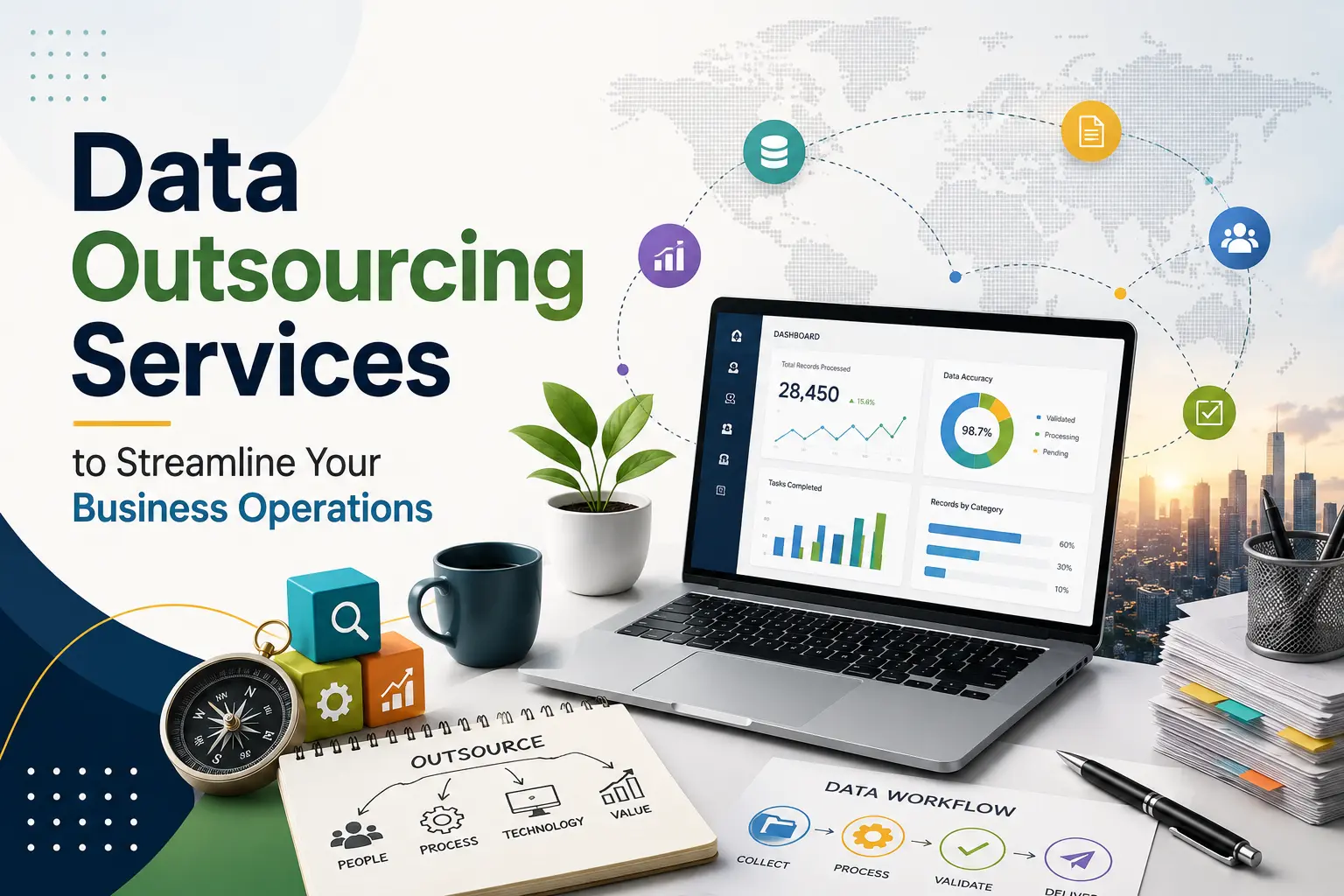
With BrainyPlus, a client can define the dataset, fields, sources, taxonomy, quality expectations, output format, and refresh requirements. BrainyPlus can then build the workflow around those specifications, from research and collection through processing, standardization, validation, delivery, and ongoing updates.
This changes the relationship from “vendor performing data entry” to “managed data operation supporting the business.” That difference becomes particularly valuable when the data is specialized.
Consider a financial research platform. It may not simply need company names and addresses. It may need revenue information, ownership structures, funding history, executives, subsidiaries, financial disclosures, ESG information, and other difficult-to-source attributes.
The same applies to market intelligence. A company may want to know which businesses are entering a market, what products they offer, who their executives are, where they operate, how they are growing, and what strategic signals they are showing. This is not ordinary data entry. It is research-intensive data production.
Where Human Researchers Become the Difference
Automation can collect information quickly. AI can identify patterns and accelerate processing. APIs can move information between systems. But business data is rarely perfectly clean.
A company can have multiple names. A product can fit multiple categories. Two sources can contradict each other. A website may describe a business differently from a regulatory filing. An executive’s title may have changed last month. Someone must make sense of those exceptions.
BrainyPlus uses a human-in-the-loop model, combining technology with researchers and quality checks so that data can be collected at scale while still receiving human validation where context matters. The company’s research workflow includes multi-source verification, processing, standardization, validation, and ongoing updates.
This is particularly useful for datasets where simply extracting text is not enough. The objective is not merely to collect information. It is to create information that can be trusted.
From Data Processing to Data Ownership
There is another important difference in the BrainyPlus model. Many businesses do not want to purchase a generic database that every competitor can access. They want their own dataset. Their own taxonomy. Their own fields. Their own research methodology. Their own proprietary intelligence.
BrainyPlus explicitly positions its model around helping data platforms, research firms, SaaS businesses, marketplaces, consulting firms, and enterprises build proprietary datasets without having to build the entire infrastructure themselves.
That creates an interesting outsourcing model. You provide the business question. You define what the data needs to accomplish. BrainyPlus builds the operational layer required to produce it. The resulting data can become an asset within your own business rather than simply another subscription to an external database.
What Does BrainyPlus Actually Outsource?
The answer is broader than traditional data processing outsourcing. BrainyPlus can support the entire lifecycle of a dataset.
Research teams can identify and collect information from relevant sources. Data specialists can structure and standardize it. Enrichment workflows can fill gaps and add context. Quality teams can validate records and identify inconsistencies. Managed data operations can then keep the dataset updated as the underlying information changes.
This can support company intelligence, people and contact intelligence, investment and financial intelligence, industry and market intelligence, product intelligence, ESG data, supply-chain information, healthcare data, and other custom datasets.
The result is closer to having a virtual data department than simply hiring an outsourced data-entry team.
What Does Data Outsourcing Cost?
This is one area where buyers should be cautious. There is no meaningful universal price for outsourced data management because the cost depends on what is being managed. A 100-field financial dataset requiring human verification is fundamentally different from basic document indexing.
Large enterprise providers such as Accenture, Genpact, Wipro, and Infosys typically scope pricing according to the project, resources, technology, volume, service levels, and complexity. Their public websites focus on capabilities rather than publishing a single standard price for data outsourcing.
For BrainyPlus, the same principle applies pricing depends on the dataset, coverage, fields, complexity, research methodology, update frequency, and resource requirements.
That is actually a better way to evaluate providers. Instead of asking, “What is your hourly rate?”, ask: “What will it cost us to receive accurate, validated, decision-ready data every month?” That is the number that matters.
The Real Cost of Not Outsourcing
There is one final calculation businesses often forget. What does it cost when your internal team continues doing the work?
If five analysts spend 20 hours each week cleaning, researching, enriching, and validating information, that is 100 hours of skilled capacity disappearing every week. Multiply that across a year.
Now ask what those employees could have accomplished if those hours were available for analysis, client work, sales, product development, or strategy. Suddenly, data outsourcing stops looking like an additional cost. It starts looking like a way to recover expensive internal capacity.
So, Who Should You Choose? – If your organization needs a massive technology transformation, a global consulting and technology provider may be the right answer.
If you need enterprise-scale data engineering, governance, migration, or master data management, companies such as Accenture, Genpact, Wipro, and Infosys deserve consideration.
But if your requirement sounds like this: “We know what data we need. We need someone to research it, collect it, enrich it, validate it, structure it, and keep it fresh.” Then the conversation changes. That is exactly where BrainyPlus is positioned.
BrainyPlus helps businesses build institutional-grade datasets without having to build the entire research infrastructure internally. Its model combines research, enrichment, quality assurance, human expertise, AI-assisted workflows, and ongoing managed data operations. The result is a simpler proposition: You define the intelligence you need. BrainyPlus builds the data operation behind it.
Ready to Build Your External Data Team?
If your analysts are buried in spreadsheets, your database is becoming outdated faster than your team can maintain it, or your product depends on data that is difficult to collect at scale, it may be time to rethink your operating model.
BrainyPlus can help you move from fragmented manual research to a structured, scalable data operation.
Whether you need data processing outsourcing, outsourced data management, custom research, data enrichment, or specialized business data services, the goal is the same: give your internal team better data without forcing them to build and manage an entire data operation themselves.
Talk to BrainyPlus about your data requirements.
BrainyPlus — Your data team, without the infrastructure burden.