Artificial intelligence (AI) and machine learning (ML) are transforming how businesses analyse information, automate processes, and make decisions. From intelligent document processing and predictive analytics to computer vision and natural language processing, machine learning applications are becoming integral to modern business operations. However, the performance of these technologies depends on a critical foundation: high-quality, accurately labelled data. This is where data annotation services play an essential role in turning raw information into meaningful inputs that machine learning models can understand and use.
As organisations generate increasing volumes of text, images, videos, documents, and structured business information, the need for reliable data annotation is growing. Businesses must ensure that their datasets are accurately labelled, consistently categorised, and relevant to the objectives of their AI applications. Without these foundations, even sophisticated machine learning models can produce inaccurate predictions, unreliable classifications, and inconsistent results.
For organisations developing AI products, building internal analytics capabilities, or expanding data-driven services, selecting the right data annotation company can make a significant difference to model performance and operational efficiency. Understanding how annotation works, what quality standards matter, and how annotation integrates with data collection and enrichment services can help businesses build more dependable AI systems.
Why Data Annotation Is Essential for Machine Learning
Machine learning models identify patterns by learning from examples. If those examples contain incorrect labels, inconsistent classifications, or incomplete information, the resulting model may learn misleading relationships. This can affect accuracy, increase the likelihood of errors, and reduce confidence in automated decisions.
High-quality data annotation services help address these challenges by establishing consistent labelling guidelines, clearly defined categories, and structured quality assurance processes. These practices allow machine learning teams to work with datasets that better reflect the requirements of their intended applications.
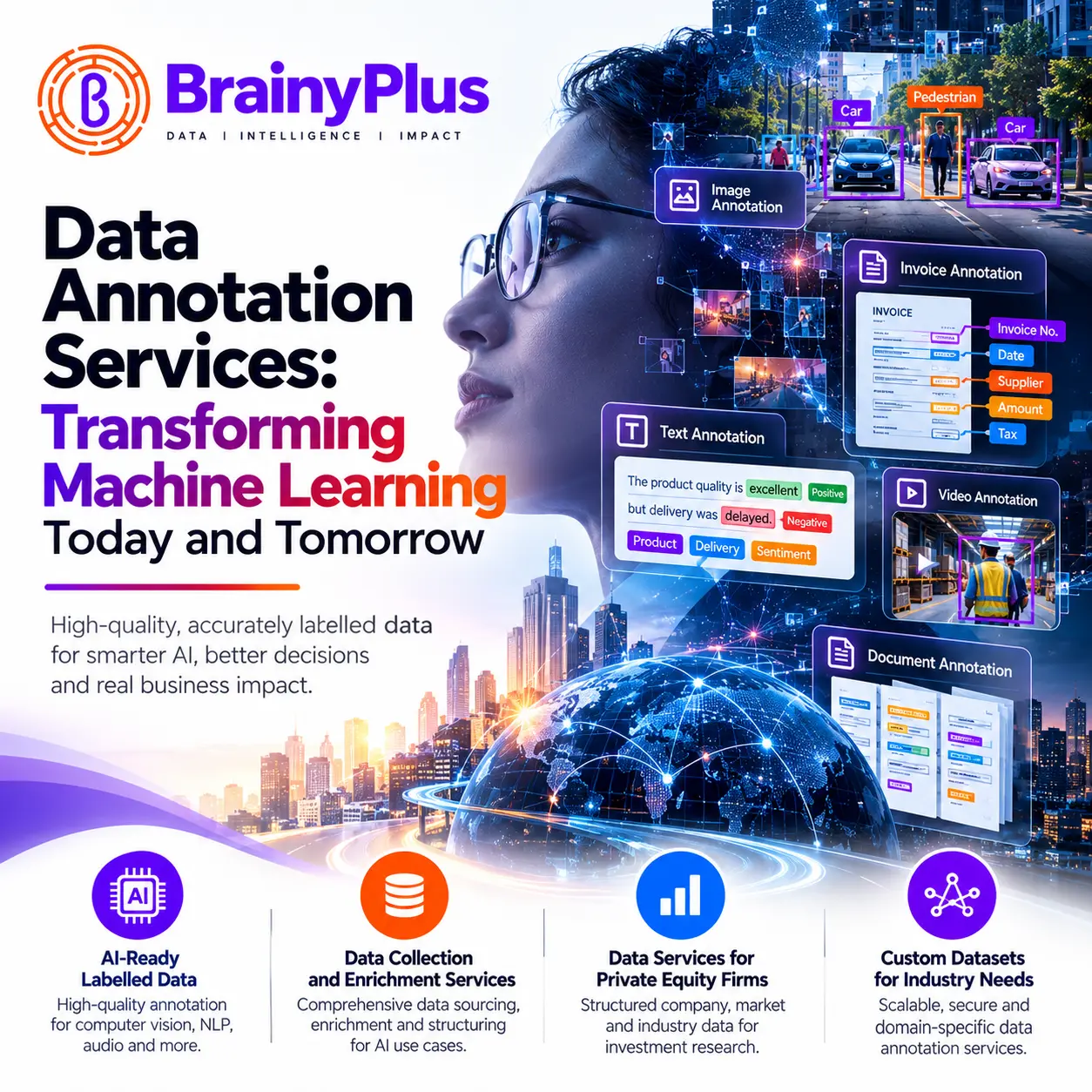
Annotation is particularly important in complex environments where context influences the correct interpretation of data. A financial document may contain several dates, but only one may represent the transaction date required by a model. Similarly, a customer statement may contain positive and negative language, making sentiment classification more nuanced than simply identifying individual words.
Human expertise remains valuable in these situations because annotators can apply contextual judgement, identify ambiguous examples, and flag cases that require additional review. Automated annotation tools can improve processing speed, but human oversight is often necessary to establish reliable ground truth and manage exceptions.
As AI applications become more sophisticated, businesses must treat annotation as an ongoing data quality function rather than a one-time labelling exercise.
The Role of a Data Annotation Company in AI Development
A dependable data annotation company does more than attach labels to records. It helps establish a repeatable process for preparing datasets, interpreting annotation requirements, managing quality, and delivering data in a format that machine learning teams can use.
The process typically begins with understanding the model’s objectives and defining an annotation framework. This includes identifying the required labels, documenting edge cases, developing examples, and establishing rules for handling ambiguous information. A consistent framework helps different annotators produce comparable results across large datasets.
The next stage involves annotation, followed by quality checks that assess whether labels comply with the agreed guidelines. Depending on the project’s complexity, quality assurance may include independent reviews, sample-based audits, agreement checks between annotators, automated validation, and escalation of uncertain cases.
A capable provider should also support documentation and controlled updates to annotation guidelines. When model requirements change or new categories are introduced, the annotation process must evolve without compromising consistency across existing data.
BrainyPlus can support organisations through structured data operations that combine data preparation, classification, enrichment, validation, and human intelligence. This approach can help businesses organise their annotation workflows around specific use cases and establish repeatable processes for producing AI-ready datasets.
For organisations with limited internal capacity, working with an experienced data partner can reduce the operational burden of coordinating annotation teams, maintain guidelines, and manage quality across growing volumes of information.
How Data Collection and Enrichment Services Strengthen Annotation
Annotation is only one stage in the broader data preparation lifecycle. Before information can be labelled effectively, businesses must often collect relevant records, remove duplicates, standardise formats, fill information gaps, and verify that the data is suitable for its intended purpose.
This is where data collection and enrichment services become important. Data collection establishes the source material required for a project, while enrichment adds useful attributes, context, classifications, or relationships to existing records. Annotation then applies the labels and structures required for a specific machine learning task.
Consider a business developing an AI-powered company intelligence platform. Its raw dataset may contain company descriptions, websites, industry information, employee estimates, and financial indicators collected from multiple sources. Before these records can support a classification model, the information may need to be standardised, matched to unique companies, enriched with missing attributes, and labelled according to an agreed industry taxonomy.
Combining collection, enrichment, and annotation creates a more comprehensive data preparation workflow. It helps reduce inconsistencies between data sources and ensures that the final dataset is aligned with the model’s requirements.
BrainyPlus supports businesses with structured data collection, research, enrichment, taxonomy development, validation, and managed data operations. These capabilities can help organisations create datasets that are not only labelled but also organised, contextualised, and ready for downstream analytical applications.
For AI developers, the benefit is a more dependable data foundation. For enterprises, it can mean less manual preparation and more consistent information across their analytics and automation workflows.
Data Services for Private Equity Firms: An Emerging Opportunity
Private equity firms increasingly rely on data to identify investment opportunities, evaluate companies, monitor portfolios, and understand market developments. Investment teams may need to analyse thousands of businesses across industries and geographies, often using information collected from fragmented public and proprietary sources.
Data services for private equity firms can help organise this information into structured datasets that support sourcing, screening, due diligence, portfolio monitoring, and investment research. These services may involve collecting company profiles, enriching records with industry classifications, standardising financial and operational attributes, and validating information against agreed sources.
Data annotation adds another layer of value by classifying companies, documents, business activities, and market signals according to specific investment criteria. For example, an investment team may need companies classified by business model, sector, geography, customer segment, or technology adoption. A structured annotation framework can help transform unorganised descriptions into comparable categories that support screening and research.
Similarly, a firm developing machine learning models to identify potential acquisition targets may need historical company information labelled according to predefined characteristics. These labels can help researchers investigate patterns across target companies, although model outputs must still be evaluated carefully and should not replace investment judgement.
BrainyPlus can create value for private equity firms by supporting company intelligence, industry mapping, executive and ownership research, data enrichment, taxonomy development, and validation of investment-related datasets. These capabilities can help investment teams build more consistent company universes, improve the usability of research information, and maintain datasets as businesses and markets evolve.
For firms developing proprietary intelligence platforms, combining data collection and enrichment services with annotation can also establish a repeatable process for preparing company information for analytics and machine learning.
The broader opportunity is to make investment research more structured and scalable, allowing professionals to spend more time evaluating opportunities and less time reconciling fragmented information.
The Future of Data Annotation: AI, Automation, and Human Intelligence
The future of data annotation will increasingly involve a combination of automated tools, AI-assisted labelling, and human review. Machine learning systems can generate preliminary labels, identify likely categories, and prioritise records that require attention. Human annotators can then review uncertain examples, correct mistakes, and address complex cases that automated systems cannot reliably resolve.
This approach, often associated with human-in-the-loop workflows, can help improve efficiency while preserving quality. However, automation does not eliminate the need for oversight. AI-generated labels may reproduce existing errors, reflect biases in source data, or perform inconsistently on unfamiliar examples.
Businesses should therefore evaluate annotation systems based on their actual performance, not simply the level of automation they offer. Clear quality thresholds, review procedures, and ongoing monitoring remain important as models and datasets evolve.
Another emerging priority is data diversity. Models trained on narrow or unrepresentative datasets may perform poorly when exposed to different languages, markets, customer groups, or real-world conditions. Annotation programmes must account for these differences and document the limitations of their datasets.
As AI adoption expands, the demand for specialised annotation, domain-specific taxonomies, multimodal data preparation, and continuously refreshed datasets is likely to remain important. Providers that combine operational discipline, technical capability, and human expertise will be well positioned to support this evolution.
BrainyPlus can help businesses establish adaptable data workflows that integrate collection, structuring, enrichment, annotation support, and validation according to project needs. This enables organisations to approach AI readiness as an ongoing capability rather than a single project milestone.
Choosing the Right Data Partner for Long-Term AI Success
Selecting a data annotation company requires more than comparing prices and turnaround times. Businesses should evaluate the provider’s understanding of the intended machine learning application, ability to follow detailed guidelines, quality assurance practices, data security measures, and capacity to scale as requirements change.
It is equally important to understand how annotation fits into the broader data lifecycle. Providers that can support data collection, enrichment, structuring, validation, and ongoing maintenance may help reduce the fragmentation that often occurs when multiple vendors manage separate stages of data preparation.
Organisations should also define clear project outcomes before work begins. These may include acceptable accuracy thresholds, dataset completeness, delivery formats, documentation requirements, turnaround times, and procedures for handling exceptions. A well-defined framework creates a common basis for measuring performance and improving the process over time.
BrainyPlus helps businesses turn fragmented information into structured and usable data assets through custom dataset development, data research, enrichment, validation, and managed data operations. By aligning these capabilities with specific business and AI requirements, organisations can build more consistent data preparation workflows and reduce the effort involved in maintaining large datasets.
Conclusion: Building Better AI Through Better Data
Data annotation services are becoming an essential component of modern machine learning, helping businesses transform raw information into labelled datasets that support classification, prediction, automation, and intelligent applications. As AI systems become more integrated into business operations, the importance of accurate, consistent, and contextually relevant data will only increase.
The strongest results come from treating annotation as part of a wider data strategy that includes collection, enrichment, validation, governance, and ongoing improvement. For private equity firms, technology companies, enterprises, and AI developers, this integrated approach can create more dependable datasets and support more scalable analytical capabilities.
BrainyPlus helps organisations establish structured data operations that support the journey from fragmented information to validated, usable intelligence. Whether the requirement involves preparing datasets for machine learning, developing industry-specific taxonomies, or delivering data services for private equity firms, the focus remains on building reliable information foundations that support business objectives.
Ready to prepare your data for AI and machine learning? Connect with BrainyPlus to explore how customised data collection and enrichment services, structured data operations, and annotation support can help your organisation build higher-quality datasets and accelerate its AI initiatives.