Financial businesses have never had a shortage of data. The challenge has always been turning that data into something structured, reliable, searchable, and usable.
A financial data platform may need information on thousands of companies. An investment intelligence provider may need to continuously track funding rounds, executives, acquisitions, financial metrics, or company developments. A FinTech company may need to build a new dataset from fragmented public sources. An AI company may need financial content collected, classified, validated, and enriched before it can be used to train or improve its models.
In each case, the challenge is similar: where do you find the right people to build the data operation behind the product? This is where a specialized financial data outsourcing company can make a significant difference.
Instead of simply providing additional manpower, the right partner can help design the workflow, identify relevant sources, build collection engines, establish validation processes, enrich the information, and create a scalable operation around the dataset.
For financial businesses, this can mean getting a new data product off the ground faster, expanding an existing dataset without significantly increasing internal costs, and accessing professionals who already understand the complexities of financial research and public-source data collection.
Financial Data Is More Than Numbers in a Spreadsheet
One of the biggest misconceptions about financial data operations is that the work is simply about collecting numbers.
In reality, a financial dataset can involve hundreds of individual fields, multiple source types, different reporting formats, changing company structures, and information that needs to be interpreted before it can be standardized.
Consider a simple requirement: build a database of private companies and their executives. The information might be scattered across company websites, regulatory records, press releases, professional profiles, funding announcements, investor websites, and industry publications. Company names may vary across sources. Executives may change roles. Some information may be outdated. Certain fields may require manual research.
Now multiply that process across thousands of companies. That is no longer a data-entry exercise. It is a data operations problem. And solving that problem requires people who understand both the data and the process required to collect it consistently.
What Does a Financial Data Outsourcing Company Actually Do?
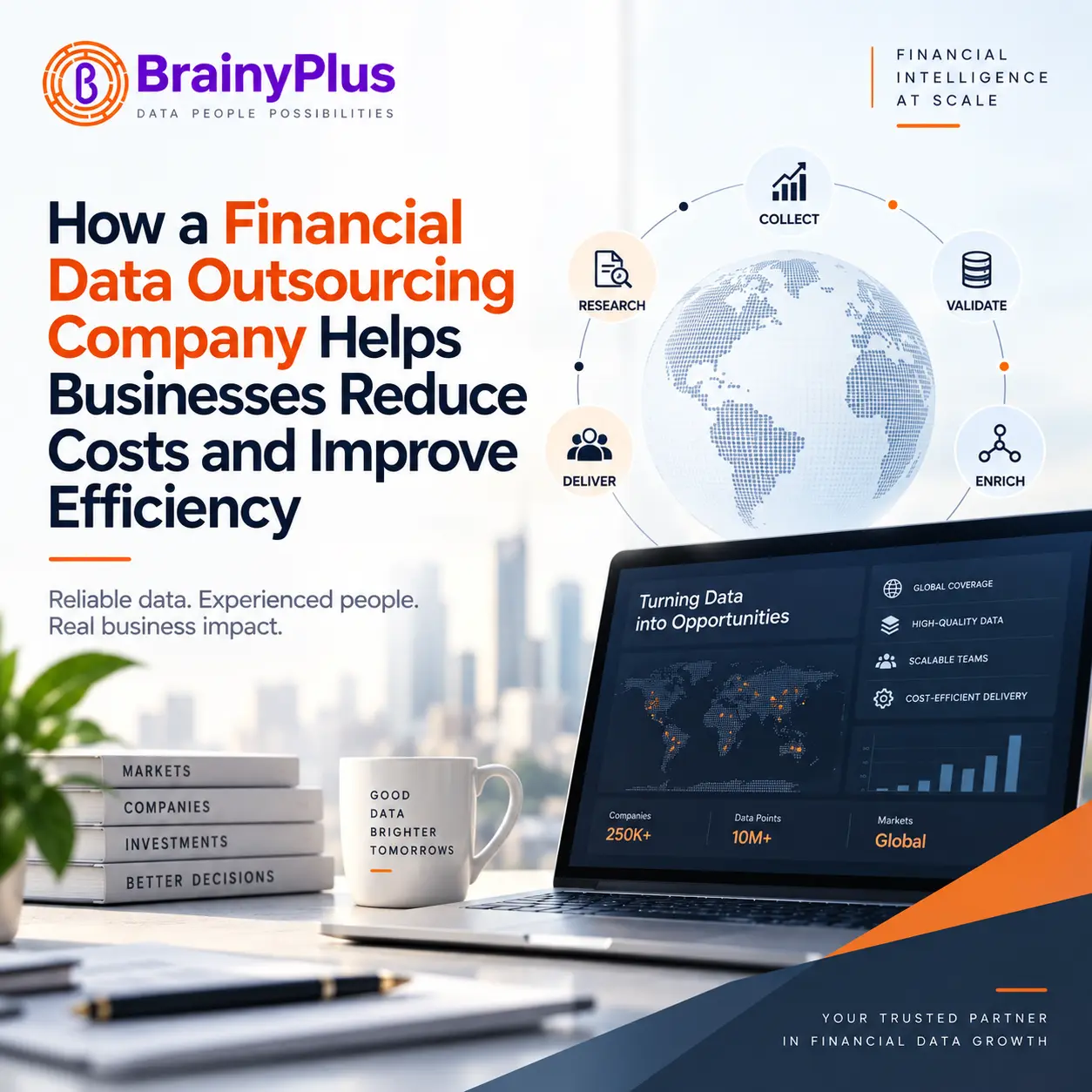
A capable financial data outsourcing company does much more than take over repetitive tasks. It can become an extension of a company’s data team, working on everything from initial research and source identification to data collection, validation, enrichment, and ongoing maintenance.
The scope can be as straightforward as collecting a defined set of information from public sources or as complex as developing an end-to-end data collection engine for a completely new dataset.
A typical engagement might begin with a business saying: “We need a dataset covering these companies, with these 50 fields, updated every month.” The real work begins after that.
The team needs to understand the data definitions, identify the best public sources, determine which information can be automated, establish rules for ambiguous cases, design the collection workflow, create validation mechanisms, and determine how the final data should be delivered. That is where experience matters.
Why Public-Source Data Collection Requires Experience
There is an enormous amount of financial and business information available publicly. But “publicly available” does not necessarily mean “easy to collect.” Information can exist in annual reports, regulatory filings, investor presentations, company websites, press releases, industry publications, government databases, financial documents, and other sources. Different sources may use different terminology and formats.
Experienced researchers learn how to navigate these differences. They understand how to locate relevant information, assess the reliability of sources, identify inconsistencies, interpret context, and structure information according to predefined data requirements.
This experience becomes particularly valuable when a dataset contains information that cannot simply be extracted through an automated rule. A seasoned analyst knows when the data looks unusual and when something needs another layer of verification.
From Data Collection to Data Enrichment
Collecting the initial information is only one part of the process. Businesses increasingly want enriched data that provides greater context around the underlying record. A company dataset, for example, might begin with a company name and website. Enrichment could add industry classification, headquarters, executives, funding information, ownership details, business descriptions, revenue indicators, employee information, geographic coverage, or other attributes depending on the dataset.
Similarly, an investment dataset could be enhanced with additional company, transaction, sector, investor, or executive information. The purpose of enrichment is to turn a basic record into a more useful intelligence asset. This is particularly relevant for financial data platforms that want to provide users with deeper insights without requiring them to conduct the underlying research themselves.
AI Content Enrichment Is Changing the Data Workflow
The next generation of data operations is increasingly combining human expertise with artificial intelligence. AI can help process large volumes of content, identify relevant information, classify documents, extract potential data points, summarize financial content, identify entities, and enrich records.
But AI-generated output still needs appropriate controls. Financial content can contain ambiguity, context, and nuances that require human review. An AI system may extract information efficiently, but an experienced analyst can determine whether the information has been interpreted correctly and whether it meets the client’s data definition.
This creates an increasingly important human-in-the-loop model. AI provides scale and speed. Experienced professionals provide context, validation, and judgment. Together, they can create a more efficient financial data operation than either approach alone.
Why Outsourcing Can Be More Cost-Efficient
Building a financial data operation internally can require considerable investment. A company needs to recruit researchers, analysts, quality specialists, managers, and potentially technology professionals. It must train them, create processes, provide infrastructure, manage productivity, and continuously handle recruitment and workforce requirements as the operation expands.
For a company whose core product is financial intelligence, this may be a necessary investment. But for many businesses, it can make more sense to partner with a specialist that already has the people and operational experience. This is where financial data outsourcing services can provide a practical cost advantage.
The business gets access to experienced resources without having to absorb the entire cost of building the capability internally. More importantly, pricing can be structured around the actual requirement. A project may need a small dedicated team, a larger operational unit, a specific dataset, or ongoing support.
A flexible model allows businesses to scale the engagement according to their data requirements rather than committing prematurely to a large permanent internal operation.
Financial Data Outsourcing Isn’t Just for Financial Data Companies
Although financial data platforms are natural users of these services, the opportunity extends much further. Investment firms, FinTech companies, private equity businesses, accounting organizations, lenders, real estate businesses, research firms, AI companies, and market intelligence providers can all have data-intensive workflows.
For some organizations, the requirement may involve financial research. For others, it may be company intelligence, executive data, industry research, real estate information, ESG data, healthcare intelligence, or another specialized dataset. The underlying requirement remains similar: collect reliable information, structure it properly, validate it, enrich it, and make it usable.
This is also where finance and accounting outsourcing can intersect with broader data operations. While finance and accounting outsourcing traditionally covers activities such as bookkeeping, reconciliations, accounts payable, accounts receivable, and reporting support, organizations can also require specialized financial data research and processing capabilities alongside these functions. The right outsourcing model depends on the business and the type of work it needs to accomplish.
BrainyPlus: Financial Data Expertise Built Around Your Dataset
At BrainyPlus, we approach financial data projects as data-building challenges, rather than simply resource requirements. Our teams undertake projects involving data collection, validation, enrichment, AI content enrichment, research, and other specialized data operations for the financial industry and related sectors.
Our professionals bring extensive experience in public-source data collection and financial intelligence operations, with team members who have worked with reputed market intelligence organizations for more than 10 years. This experience allows us to work with businesses that already have a defined dataset as well as organizations that are still figuring out how the data should be collected.
We can work with a client’s specifications, understand the required fields and definitions, identify appropriate sources, establish the collection methodology, and develop a repeatable data collection engine around the dataset. The result is intended to be more than a completed project. It is an operational framework that can continue to support the business as the dataset grows.
Transparent Pricing Without Unnecessary Complexity
Outsourcing becomes much easier to evaluate when pricing is transparent. Businesses should know what they are paying for, what resources are involved, how the engagement can scale, and what happens when the scope changes.
BrainyPlus follows a transparent, flexible, and cost-efficient pricing approach, allowing businesses to structure data operations around their actual requirements. Whether the requirement is a specific project, an ongoing data operation, a dedicated team, or a new dataset development initiative, the engagement can be designed around the nature and scale of the work.
This gives financial businesses an opportunity to access experienced data professionals without making the same level of investment required to establish a large internal operation.
The Real Advantage: Experience + Process + Technology
Financial data outsourcing works best when three elements come together. Experience helps professionals understand the data. Process ensures the work can be repeated consistently at scale. Technology makes it possible to process increasing volumes efficiently.
Remove any one of these, and the operation becomes less effective. Technology without experienced validation can produce unreliable information. Experienced researchers without structured processes can struggle to scale. A strong process without appropriate technology can become unnecessarily expensive and slow. The combination creates something more valuable: a scalable financial data operation that can evolve alongside the business.
The Future of Financial Data Operations
The financial industry is moving toward increasingly specialized datasets, automated workflows, AI-assisted research, and continuously updated intelligence. Companies will continue to need more data, but they will also need better data.
That means the competitive question is shifting from “How much data can we collect?” to “How efficiently can we create reliable, decision-ready data at scale?”
For many businesses, building every capability internally may not be the only answer. A specialized financial data outsourcing company can provide the experience, resources, processes, and technology required to build the operation behind the data. With the right partner, a dataset that begins as an idea can become a structured, validated, enriched, and scalable intelligence product.
Conclusion
The value of financial data outsourcing services goes far beyond reducing the number of people working on a project. Done properly, outsourcing can give businesses access to experienced professionals who understand financial information, public-source research, data validation, enrichment, and the operational discipline required to build datasets at scale.
For companies dealing with complex financial information, financial data processing services can provide the infrastructure needed to transform fragmented public information into structured and usable intelligence. And for organizations looking beyond data operations into broader financial functions, finance and accounting outsourcing can complement these capabilities.
At BrainyPlus, our focus is on helping businesses make that transition—from a data requirement to a functioning data operation.
Whether you need a new dataset built from scratch, an existing database enriched, large volumes of information validated, financial content enhanced using AI, or a dedicated team to manage ongoing data operations, BrainyPlus brings seasoned professionals, industry experience, and flexible delivery models to the table.
Have a dataset you want to build? Let’s make it happen.
Write Us at info@brainyplus.com